Hastings – The Rainwater Basin Joint Venture presented three Wetland Stewardship Awards during its annual Informational Seminar on February 8. The award recognizes significant contributions to wetland conservation in the Rainwater Basin region of south-central Nebraska.
Angie Biester and the late Gary Biester, of Clay County, were recipients of the Landowner Wetland Stewardship Award. The Biesters enrolled two sites in the Wetlands Reserve Program and a third site in the Conservation Reserve Program in 2001. In 2010 the couple applied to enroll an additional 46 acres in WRP; after Gary’s unexpected death in July, Angie saw the project through to completion. U.S. Fish and Wildlife Service biologist Laurel Badura, who nominated the Biesters on behalf of the Wetlands Reserve Program Team 5, said “Gary and Angie believed that landowners should farm the best and leave the rest for wildlife…They leave a family legacy that few others can match.”
Roger Hammer, retired Soil Scientist for the Natural Resources Conservation Service, received the Agency Wetland Stewardship Award. Hammer was project leader Read more »
Grand Island — The Rainwater Basin Joint Venture will host its 17th annual Informational Seminar on Wednesday, February 8, at the Hastings Hotel and Convention Center, 2205 Osborne Drive East, in Hastings, Nebraska. The one-day seminar, which begins at 9:15, is an opportunity for landowners, agriculture producers, natural resource professionals, and other interested individuals to share ideas and learn about conservation issues, research, and habitat programs in south-central Nebraska’s Rainwater Basin region.
Nebraska State Conservationist Craig Derickson of the USDA Natural Resources Conservation Service will provide opening remarks. This year’s presentations include: what to expect from a wetland restoration project on your land; compatible use in the Wetlands Reserve Program; legal and financial aspects of creating a conservation easement; and results of a study examining the effects of grazing or forage and other grassland vegetation. Brett Haglund, president of the Sand County Foundation, will present “Axe, Plow, Cow, Fire, and Gun: Revitalizing Private Lands for Wildlife Habitat by Innovative Use of Traditional Tools.” In addition, throughout the day Rainwater Basin landowners who have participated in Joint Venture projects and other wetland programs will discuss their experiences.
The seminar is open to the general public. Agenda details will be available at www.rwbjv.org after January 16. To register, please send an e-mail by January 31, to shanda.weber@ne.usda.gov; include name, organization, and mailing address. Or phone 402-463-6771 ext. 112. A $25 registration fee, payable at the door, covers all sessions, snacks, and a buffet lunch. Landowners and agriculture producers in the Rainwater Basin are invited to register free of charge.
The Informational Seminar is funded in part by a grant from the Nebraska Environmental Trust.
The recently completed Sedimentation of Nebraska’s Playa Wetlands: a Review of Current Knowledge and Issues, published by the Nebraska Game and Parks Commission, is available to download at www.NebraskaWetlands.com.
The document discusses Nebraska’s playa wetlands and the process of sedimentation, and the effects of culturally accelerated sedimentation on wetland function.
August 19, 2011 Funk, Nebraska — Ronnie Sanchez is the new project leader of the U.S. Fish and Wildlife Service’s Rainwater Basin Wetland Management District. Sanchez has worked for nineteen years for the USFWS National Wildlife Refuge System, at refuges in Washington, Montana, South Dakota, and Nebraska. He served as the Rainwater Basin WMD’s deputy project leader since 2005, and succeeds Gene Mack, who retired in April.
The Rainwater Basin WMD manages Read more »
The Rainwater Basin is one of fifty sites featured in the U.S. Fish & Wildlife Service’s Open Spaces blog project, entitled “50 Stories, 50 States, 50 Days.” The stories included in the project highlight the effects of accelerating climate change on fish and wildlife around the country. The goal of the project, which was launched this spring on Earth Day, is “to show the broad scope of changes and emerging trends we’re just beginning to understand, as well as collaborative efforts to respond across the nation.” Click here to see the Rainwater Basin story.
Lincoln – Rainwater Basin wetlands and wildlife habitat will benefit from $338,373 in grants announced in April by the Nebraska Environmental Trust.
The Rainwater Basin Joint Venture will receive $150,000 for the Wetland Habitat, Restoration, and Protection grant, which will help increase the quality and quantity of the region’s wetland habitat on public and private land. Grant funds will support incentive programs to assist private landowners with water and vegetation management in their wetlands. This is the first-year award, with potential for an additional $150,000 second-year funding.
The Joint Venture will receive a second-year award of $78,750 for the Rainwater Basin Wetland Management for Improved Migratory Bird Habitat grant. Read more »
On March 16-17, the RWBJV and Playa Lakes Joint Venture co-hosted the Playa Wetland Research Symposium in Grand Island. More than eighty people attended, representing 23 natural resource agencies, conservation organizations, and universities in eleven states.
The symposium was held in conjunction with the Waterbird Society’s annual conference. Abstracts of the 29 presentations given at the symposium, as well as contact information for the presenters, is available at PLJV’s website.
Secretary of the Interior Ken Salazar visited the Rainwater Basin and central Platte River on March 14 to witness the spring waterfowl and crane migration, and to call attention to the work of south-central Nebraska’s conservation partnerships, which he called “the heart and soul of President Obama’s Great Outdoors Initiative.”
Secretary Salazar accompanied RWBJV partners to Funk WPA in Phelps County, where they watched tens of thousands of northern pintails fly overhead. Later, at Clark SPA in Kearney County, the Secretary met Steve Nelson, one of five nearby landowners who cooperated with RWBJV partners to fill irrigation pits and restore the Clark wetland.
He praised the work of the Rainwater Basin Wetland Management District, saying it was, “a model for conservation in the 21st century, built from the ground up with a view toward health lands, waters, wildlife, and economies.”
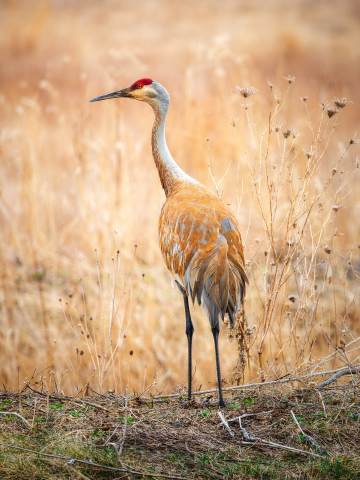
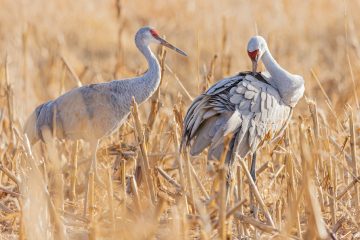
In the evening he visited one Rowe Sanctuary’s observation blinds on the Platte River, and watched sandhill cranes fly in to their nighttime roost on the river.
Links to news coverage of the secretary’s visit are on the News Media page.
Grand Island – A new conservation program offers eligible Rainwater Basin landowners the flexibility of crossing an irrigation pivot over enrolled wetland and associated upland acres. The Rainwater Basin Joint Venture cooperated with the Natural Resources Conservation Service to develop a pilot Wetlands Reserve Enhancement Program, which is available only in the Rainwater Basin wetland complex.
The program is similar to the better-known Wetlands Reserve Program, in which a landowner receives financial incentives to restore, enhance, and protect wetlands in exchange for placing marginal, flood-prone land into a conservation easement. Under easement terms of the new WREP, the landowner retains the right to cross a pivot through the enrolled wetland to irrigate the surrounding cropland or pasture. Read more »
Grand Island – Agriculture producers in the Rainwater Basin region have an opportunity to fill abandoned irrigation re-use pits and thereby increase their productive acres under a Special Initiative program offered by the Natural Resources Conservation Service.
The Rainwater Basin Watershed Initiative is part of NRCS’s Wildlife Habitat Incentives Program, and is focused on pits located in the watersheds of state Wildlife Management Areas and federal Waterfowl Production Areas. The Special Initiative was developed in cooperation with the Rainwater Basin Joint Venture, whose research indicated that the program would benefit local producers as well as the wildlife that use public-land habitat. Read more »