News
Prescribed Burn Associations Join Forces To Fight Cottonwood Wildfire
April 22, 2026
Story by Steve Moseley in coordination with the Rainwater Basin Joint Venture partnership.
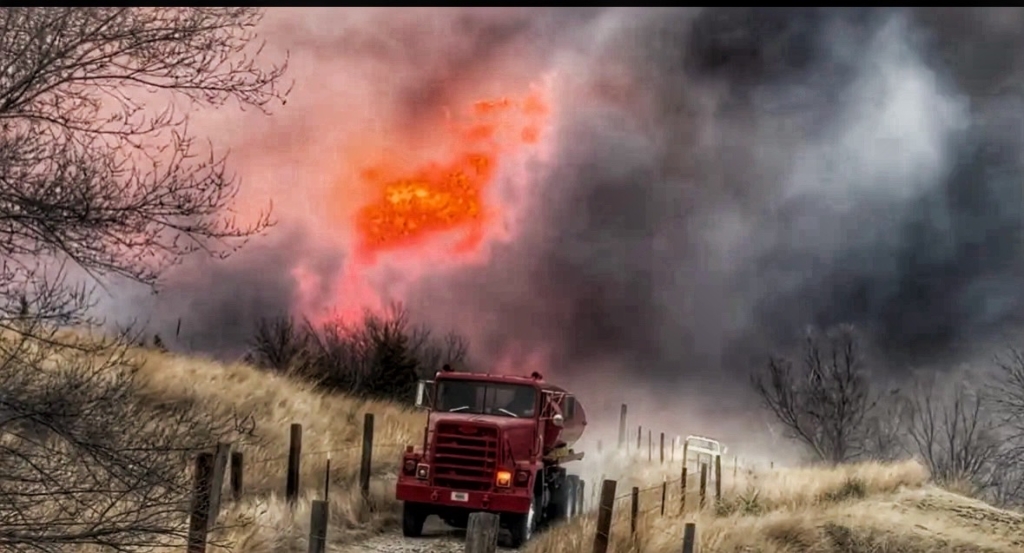
It’s been a memorable wildfire season in Nebraska … an all-time record season in fact.
Multiple wildfires ravaged grasslands to the tune of more than 800,000 acres in combination for the so-named Cottonwood, Morrill and Road 203 wildfires alone. Livestock grazing was incinerated, miles of expensive fenceline destroyed, houses and outbuildings placed in deep peril.
And there were other fires in addition to those three.
In the process of rapid expansion the community of Farnam, located south of Gothenburg, had to be evacuated to keep its people from harm’s way.
Of course, dozens of local fire departments were engaged in the battle. Alongside them every step of the way were much lesser-known warriors flying under the radar of publicity. Most are rangeland property owners already in place as members of local prescribed burn groups of like-minded neighbors who share a grazing lifestyle.
In a Central Nebraska Today website piece, writer Brian Neben said more than 92 fire departments and task forces pitched in together against the Cottonwood wildfire.
Lexington fire chief Bo Berry told Neben, “This fire has proved the necessity for the control of the spread of cedar trees (via prescribed fire)” because “they are highly flammable and can aid in the spread of wildfires.”
From Brady, Chief Mike Gruber said the Loess Hills Prescribed Burn Association dove into the battle immediately.
“The very first day they were involved in it. They worked right along beside us” on the fire lines. “They helped us a ton” even before the flames began to rage over “a bunch of that (area) where we had already burned pastures in the past through our prescribed burn process” which “made it a little easier to try to get a handle on the fire because the bulk of the bad trees were already gone. It makes it a lot easier to handle a wildfire when they (prescribed burn alliances) are involved. Basically, how we got it stopped was by putting fire on the ground.”
Straight south of Brady in Frontier County, Curtis fire chief Tim Nicholson agreed; prescribed burn alliances are game changers for local departments when wildfire raises it destructive head.
Of the Loess Hills organization, he said, “They were already there before we even got dispatched. With any fire they automatically dispatch themselves.
“To me they’re an invaluable asset because the (LCRA) membership is, like, 150 individuals.” With their extensive equipment, “It’s kind of like having another two fire departments” on scene.
The impact is immediate and crucial in all-hands-on-deck disasters like the Cottonwood wildfire.
“Every acre they burn and every cedar tree they burn, that’s something we don’t need to worry about when we have the dry lightning storms go through. Traditionally, if it’s red and hot you put water on it. Well, with prescribed burns they fight fire with fire. They use the drip torch” and “back burning.
“It’s something we weren’t exposed to previously. It wasn’t a tool we had in our toolbox” however “with these guys able to do that, we’ve actually had some training” on prescribed burn planning and management for their own local firemen.
At Cottonwood, he said, “There was backburning going on all the time” which “helped significantly to slow the fire down.”
The big picture about PBAs according to Chief Nicholson? “They’re an asset to every volunteer fire department and if anyone’s against them” he will rise to argue vigorously in their defense.
Scott Stout, burn boss for the Loess Canyons Rangeland Alliance and a resident cattleman in the Loess Canyons, was among that group’s members to race into the fray, immediately deploying their extensive experience, manpower and equipment.
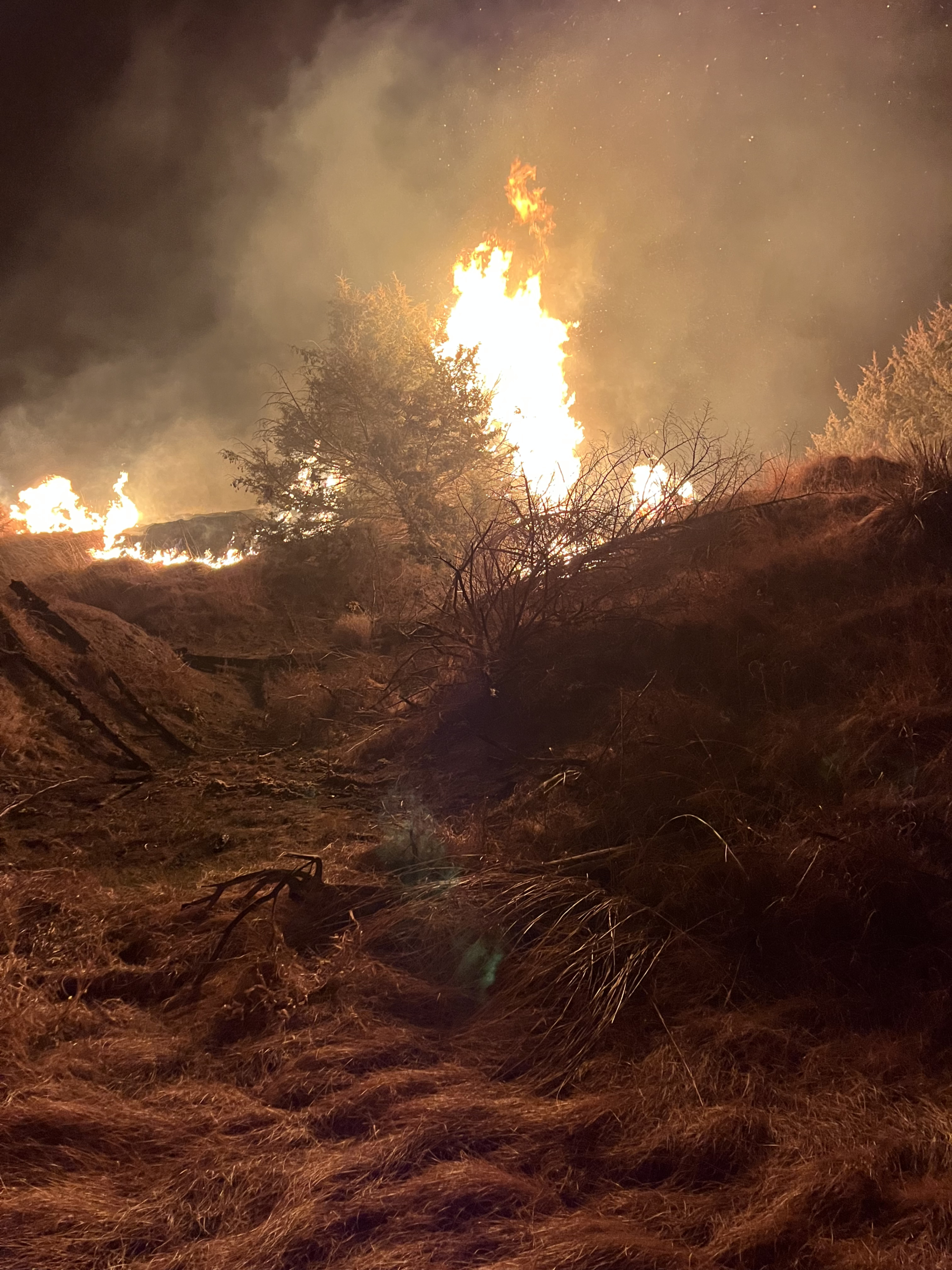
It was quickly apparent that their years of prior experience using prescribed fire to preserve and enhance grasslands would prove pivotal when the task was reversed to one of suppressing wildfire.
Stout said a call came from Brady fire chief Mike Gruber inquiring if there had been any smoke spotted. So, Stout and others hopped in their pickups and went to check. Yes indeed, there was smoke.
“We were so close to the ignition part of it that we were one of the first ones on the scene,” he said of the immediate call to action. “It was running pretty hard. We were just trying to fight it. Get it knocked down enough we could get ahold of it. It just wasn’t responding and from that point on we were notifying other members, starting to get all the help we could get.
“We fought that thing from the start” until 1 or 2 in the morning when it switched to a northerly direction. “Then we had to return to our ranches and homes and start the evacuation part of it,” he said.
Soon the raging inferno had spread across all local fire department districts and the Loess Canyons PBA members began working hand-in-hand with them.
Stout said it soon became evident areas that had been burned earlier proved an asset in this suppression crisis.
In one example, he said a previous 500-acre prescribed burn around Gruber’s home place “established a black line (burn line with no fuels) perimeter that helped stop the fire and save the chief’s house and livelihood.
Those earlier surgical prescribed burns eliminated highly flammable eastern redcedar trees and other fuels that would have otherwise been available and that helped stifle the wildfire.
Also, he added, our members “have knowledge of fire that a lot of the other local fire departments aren’t generally able to experience. We were able to utilize that knowledge” and “that helped keep the burns and fire lines at bay.”
Prescribed Burn Alliance members know the lay of the land because they own and operate on it daily and possess vital access knowledge about where they can travel and where they cannot.
That knowledge of remote locations and intuition helps, he said, “When fire turns against the land.”
Local volunteer departments are of necessity limited by manpower numbers and resources in the face of a rampaging wildfire.
Stout said his own local department, as an example, only has about 20 members.
As a result, “They have that confidence in us to get done what we need to get done” which is the ability “to fight a fire in these canyons” with their private mobile units that municipal fire departments “just wouldn’t be able to get to.”
The Loess Canyons PBA was developed in 2002, Stout explained. “Members helping members was kind of the whole idea from the start.”
Over time, members came to own their own fire equipment that is available to them at a moment’s notice the year round. Loess Canyons PBA now includes some 75 members and 13 to 15 fire units in addition to what the local VFDs have available.
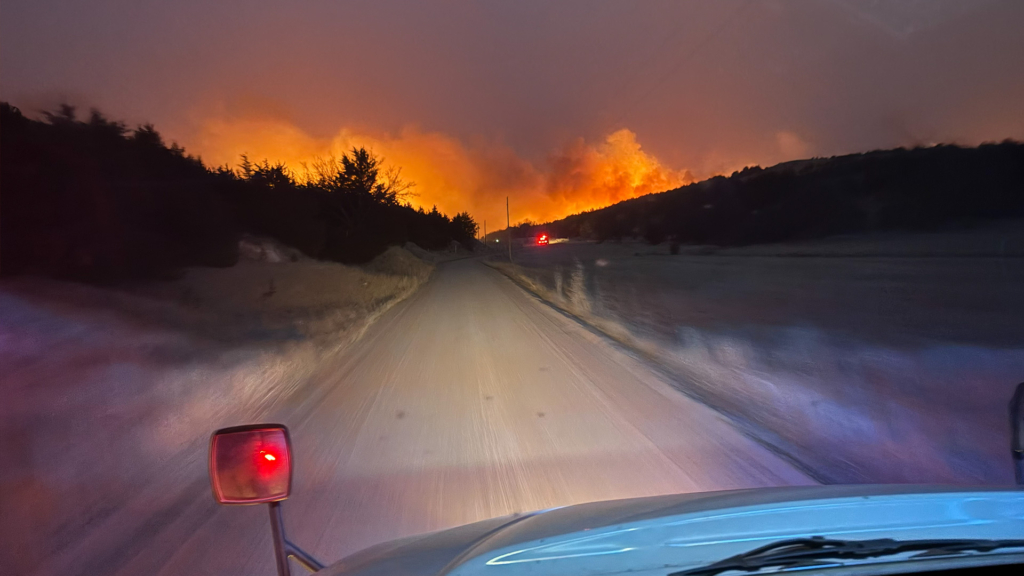
“It really boils down to living here,” Stout continued, “a way of life and trying to maintain what we have” in the face of an eastern redcedar infestation “that has moved in and kind of taken over.”
To date his PBA alone has burned 100,000 acres in the Loess Canyon country, “to restore the natural way of things before the eastern redcedar came in.”
The result has protected livelihoods and reduced wildfire risk. One vital asset of their presence is the recently demonstrated ability of PBAs to turn their guns in the opposite direction, so to speak, when outbreaks occur like they have this year.
Stout is most proud of how the associations have brought neighbors together again. It wasn’t always that way, but now there’s a sense of community everybody had “kind of gotten away from.” Now, he said, neighbors feel a duty to help one another in any crisis or calamity.
Mark Alberts of Gothenburg, president of the Central Platte Rangeland Alliance, was also deeply enveloped in the Cottonwood wildfire.
Coincidentally, Alberts and his associates were already mobilized and deployed on a prescribed burn site when the Cottonwood wildfire started.
They got a message “All hell’s breaking loose!” and at first thought it was related to their own burn, but not so. It was the alarm for the Cottonwood wildfire.
He said, “There was a lot of fire” south of Gothenburg, but they initially “got ahead of it with a backburn that stopped it.”
Alberts agrees PBAs are “very important” in fighting fire. “It’s just a blessing to see all the people that came together and worked all night in the cold and wet.”
He and his team have the tactical advantage of familiarity and comfort being out in the rugged hills and terrain.
“Fire behavior out in the pastures and rangeland is a lot different than a burning house” local fire districts more often face. “If we were called to help with a burning house we might not know how to do it.”
To demonstrate the extent of the eastern redcedar threat, he said a single mature tree will produce 1 to 1.5 million seeds a year. Those that sprout will begin producing their own seed in just five or six years.
“So it’s kind of a runaway train. It can’t be stopped.”
The answer he said, is to take defensive initiative and don’t give up. Fire itself, he added, is the most effective method of wildfire control.
The Cottonwood wildfire has been festering 25 years, Alberts said, “waiting for the stars to align, which they did.”